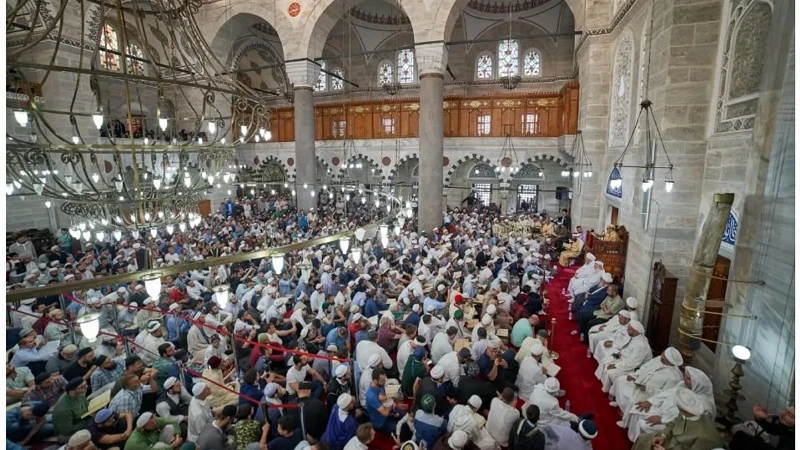
The Sahih Muslim Sama’ Assembly
By Mahmut Ay, Yeni Şafak Gazete Yazarı
Article Published in Yeni Şafak Haber Merkezi on 14th August 2026
On the occasion of the recital of Sahih Muslim in Istanbul 14–23 August 2026
yenisafak.com | Translated on FB
Islam, from its very first day, is a religion learned not from books but from “people.” Its first teacher is the Prophet himself (peace be upon him). The noble Companions acquired Islam from his blessed words and actions. The generation of the Successors likewise learned the religion not from books but from the Companions, and in subsequent periods, Islam was always transmitted from person to person. In our civilisation, contact with people has always been far more important and prioritised than contact with books. In Islamic civilisation, knowledge is not merely an object read in lines of text; it is also a living memory, emotion, and spirit transmitted from breast to breast. The most vivid example of this scholarly tradition based on person-to-person transmission is the hadith assemblies that have continued for centuries. As one of the most deeply rooted scholarly traditions in history, hadith assemblies have been the most important means of keeping this living memory and animating spirit alive, and of carrying the Prophet’s spirituality and guidance across the ages.
The first hadith assemblies were the conversations of the Messenger of Allah (peace be upon him) in the Prophet’s Mosque. In these assemblies, the noble Companions would fall silent at the feet of the Master of the Universe and strive with the utmost sensitivity and care to learn the Prophetic pearls of wisdom that would issue from him, engraving them upon their hearts and recording them in their memories. Some would even write down the hadiths with the Prophet’s permission, within the means available at the time. From that day to this, hadith assemblies established in every corner of the world are an extension of the Prophet’s hadith assemblies. The scholars who attend these assemblies have always done so – and must do so – with this awareness. In those assemblies, it is not only the words of the Prophet (peace be upon him) that resonate, but his breath and fragrance also spread, and his spirituality and blessings are felt.
From the time of the Successors onward, hadith assemblies were regularly held in mosques and in the homes of scholars. In the earliest centuries, great care was taken in these assemblies to accurately preserve the hadiths – mostly using the methods of discussion, examination and deep scrutiny – to provide information about narrators, and to explain their meanings. The rapid recitation of hadiths in scholarly assemblies using the sard method has also been a longstanding tradition.
From around the 6th century AH onward, the tradition of rapidly reciting and completing major hadith books for spiritual blessing (tabarruk) began. Particularly during times of war and epidemics, the practice of completing Sahih al-Bukhari became customary.
One of the earliest known examples is the completion of Sahih al-Bukhari in congregational gatherings before the Battle of Ayn Jalut in 658 AH/1260 CE, when the Mamluks defeated the Mongols, seeking victory for the Islamic army. It was believed that the Bukhari khatams had spiritual benefit in achieving this victory, and thereafter, reciting Bukhari in wars against the unbelievers became a tradition.
In the Ottoman period as well – according to available records – it is known that congregational Bukhari khatams were performed for tabarruk during times of war and epidemics, or at the inauguration ceremonies of buildings such as mosques and libraries, particularly from the reign of Sultan Mahmud I onward. During the Battle of Gallipoli, Bukhari completions were held throughout the country by order of Sultan Reşad.
During the National Struggle, on the opening day of the Grand National Assembly on April 23, 1920, a completion of Sahih al-Bukhari was performed at the Hacı Bayram Veli Mosque in Ankara alongside completions of the Qur’an; moreover, a circular issued by the Assembly called for Bukhari khatams across the entire nation for the victory of our army.
These are examples of this tradition in our recent history. This historical fact is a sign that the Turkish army, in its most trying times, regarded the Qur’an, the hadiths of the Messenger of Allah, and his spirituality as a spiritual refuge.
Some handwritten hadith manuscripts contain sama’ records. These records include information about who read the book from beginning to end and from which hadith scholar. Some contain extremely interesting details.
One of the finest examples is the sama’ record of hadith assemblies held in 634/1236 at the Ashrafiyya Dar al-Hadith in Damascus, found in a manuscript copy of Al-Bayhaqi’s Al-Sunan al-Kubra in India. This sama’ record, which Shaykh Abd al-Fattah Abu Ghudda described as “the most perfect sama’ record I have ever seen” (Al-Isnad min al-Din, p. 104), records everything with such meticulous care that when one sees this precision, one better understands the value given to knowledge in that period and the level of institutionalization in scholarly establishments.
Unfortunately, only the eighth volume of this manuscript has reached us. But even the records present in this single volume contain highly detailed information: where and when these assemblies were held, the name of the teacher who conducted the sama’ (musmi’) and the reader (qari’), the names of those who completed the sama’ from beginning to end, on which dates who heard up to which heading, who missed which sessions because they dozed off during the assemblies, and who spoke to one another during which sessions – all recorded in detail. All these meticulous records show how carefully and disciplined these assemblies were conducted, and that certain individuals were specially assigned to keep detailed records of those attending.
In recent years, the revival of this deep-rooted scholarly tradition in our country, and the increase in hadith sama’ assemblies using the completion method in our mosques and scholarly centers, is a great cause for gratitude.
In 2019, the Sahih al-Bukhari Sama’ Assembly led by the great Syrian scholar Sheikh Muhammad al-Yaqoubi at the Edirnekapı Mihrimah Sultan Mosque aroused great excitement in the scholarly world. – The hadith sama’ assemblies held every year since 2024 at the Yavuz Sultan Selim Mosque have also become an international scholarly . – The Abu Dawud assembly held in recent months in Istanbul under the leadership of Sheikh Ayman Suwayd was a separate blessing. Now, the people of knowledge are experiencing the spiritual excitement and enthusiasm of tasting the blessings of a new hadith festival.
Today, the Sahih Muslim Sama’ Assembly begins at the Mihrimah Sultan Mosque under the leadership of Sheikh Muhammad al-Yaqoubi. It will continue for ten days from the dawn prayer to the night prayer and will conclude on August 23. To attend this hadith festival to the extent possible and breathe in its spiritual atmosphere will be a great felicity.
Sheikh Muhammad al-Yaqoubi, who comes from the pure lineage of the Prophet (peace be upon him), is a highly respected scholar with worldwide recognition and students, possessing profound expertise in nearly all Islamic sciences. One of the qualities that sets him apart is his fusion of knowledge with spiritual insight and of teaching with spiritual guidance. In addition to being a great scholar, he is a master of the Shadhili order with numerous disciples in the Islamic world, Europe, and America. Among living Sufi masters, he is one of the foremost in terms of scholarly rank.
The sectarian and ideological divisions in today’s Islamic world unfortunately affect the scholarly world as well. However, hadith assemblies are by nature unifying and encompassing. For these assemblies are the assemblies of the Messenger of Allah. Their true host, true teacher, and true guide is He. Therefore, regardless of distinctions of congregation, community, party, sect, or disposition, all believers – especially scholars – who carry the love of the Prophet (peace be upon him) in their hearts should strive to attend this assembly.
All our brothers and sisters who wish to benefit from this scholarly festival – which we believe will be a means of mercy and blessing for our city and our country – who wish to hear the blessed words of the Prophet in his assembly, and to feel his breath and fragrance, are invited to this assembly.
Published in Yeni Şafak on 14th August 2026