Course 2025
ABOUT THE BOOK
Al-Adab al-Mardiyya is a unique book about the outward and inward courtesies required by every traveller on the path to Allah subhanaHu wa ta’ala – especially with regards to his guiding Shaykh; three hundred pages filled with marvellous meanings, waiting for pearl fishers to dive for. It is no exaggeration to say that it will revive the suluk and redirect the course of anyone who studies it with full attention and absorbs and applies its meanings.
ABOUT THE AUTHOR
The Shadhili master Muhammad ibn Ahmad al-Buzidi was one of the early companions and first khalifa of Imam Al-‘Arabi al-Dirqawi. He was the Shaykh of Imam Ahmad ibn ‘Ajiba – may Allah sanctify their secrets.
COURSE INFO
Brothers and sisters are invited to online weekly sessions to read and deliberate these precious teachings. The book will be read in Arabic and explained in English.
Online Course 2025/2026
Invitation to join
By the tawfiq of Allah ta’ala and the permission and support of our noble Shaykh Muhammad al-Yaqoubi hafizhahu Allah, we intend to study the entire book from beginning to the end, reading it in Arabic and explaining the text in English.
Registration form
26th October 2025 (Section 1)
21st January 2026 (Section 2)
25th March 2026 (Section 2 cont’d)
15th April 2026 (Section 3)
Catch up sessions
Question: How to deal with love for power and prestige
Answer Students notes from “Towards Ihsan” UK Tour 2026, Barking, 28th of June 2026 with His Eminence Shaykh Muhammad al-Yaqoubi.
This extensive answer covers aspects of Sufi Tarbiyya, the method of Imam Al-Darqawi and Imam al-Buzidi in their time, compared to the general method of Imam Abul Hasan al-Shahdili, and how to approch deseases of the heart in modern time and way of life
Someone asked a Shaykh about this, and they replied that you have to think about death a lot. I say: this answer is wrong. Love for power, prestige and leadership is integral in us. It is one of the inherent qualities we have.
I don’t know about non-Arabs, but Arabs are all leaders. If you know history: unification between Syria and Egypt took place in 1958. The president of Syria, Shoukry Kouwatli, met with Jamal Abdel Nasser, the president of Egypt then and told him, I’m handing Syria to you with 4,500,000 citizens and 4,500,000 presidents. Because they all love leadership, they all want to be leaders.
We should remember the words of Al-Hassan Al-Basri, “The last thing that gets out of the hearts of the champions of truth is love for leadership.” This is about the champions of truth – so what about us?
There is nothing wrong in having love for leadership. And if anyone tries to treat a beginner, to get rid of love for leadership, it will destroy any possibility for yout to improve, even spiritually. You are not going to improve. Imam Abdul Abbas al-Mursi explainedthat the shortest way for one to reach Allah SWT goes through the way that is in conformity with one’s nature. Not against your nature. (…) (5:13) Anyone who tells you that you can reach Allah SWT with a lot of struggle is making it difficult for you.
There was once a businessman from Tunisia, who was very wealthy. He was married to four wives, had a lot of business and real estate. He went to a sheikh, who told him to divorce his wives, give away his wealth, and stop pursuing his business, and he put him in khalwah. But he got nothing out of it. When he went on hajj, he met Imam Abu al-Abbas al-Mursi, the khalifah of Imam Abu al-Hassan al-Shadili, may Allah be pleased with them. Imam Abu al-Abbas al-Mursi told him, return to Tunisia, bring back his wives, and go back to business. He gave him the wird, and taught him how to do muraqaba, observing Allah SWT. So he went back, and he reached Allah SWT and became a man of Allah. He didn’t need to abandon all of this.
The foundation of the Shadili Tariqa is on what is in your heart, meanings achieved in the heart. Of course, with ‘ibadat and adhkar, and sometimes mujahadat, forms of self-struggle.
The same with love for leadership. I’m keen for you to have love for leadership, then you are probably a future wali, a future murshid, a future great scholar, a future leader for the Muslim Ummah. It is better if you are a successful Sufi, and a president, or a minister, or a CEO of a big company, or a multi-millionaire. This is better for the Muslim Ummah. It’s better if I can make of you a great successful man, who loves leadership, but can put leadership in the right place, in the right time. Our job is to direct your love for something rewarding, for something that brings you to Allah, not something that takes you away from Him. These qualities are integral within us. Love for leadership, generally speaking, in dunya matters, is a good quality — not a bad quality.
The right preparation produces leaders with right qualifications. So why kill it? Direct it, orient it, control it, then you will be a leader, but at the same time a servant of the people you lead. You’re a leader, but for the sake of Allah. And when you’re mistaken, then you just apologise.
(9:00) This is the first speech that Sayyidina Abu Bakr as-Siddiq, may Allah be pleased with him, delivered when he was selected as Khalifa:
[Recital by Sayyid Idris al-Yaqoubi] (check)بسم الله الرحمن الرحيم خطوة سيدنا أبي محمد سبيل خطوة الله تعالى عنه ومنها وإلى الخلافة حمد الله وأثنى عليكم وقال أيها الناس إني قد بليت عليكم ولست بخيركم أيها الناس إني قد بليت عليكم ولست بخيركم فإن رأيتموني على حق فآمنوني وإن رأيتموني على باطل فسددوني أطيعوني ما أراه وراه فيكم فإذا عصيته فما قراتيني عليكم أما إن أقراكم عني ضريف حتى أأخذ الحق منه وضريفكم عني قوي حتى أأخذ الحق منه أقول قبل هذا أستغفر الله منكم السلام عليكم ورحمة الله وبركاته
The Prophet (s) had prepared Sayyiduna Abu Bakr as-Siddiq for leaderhip. But what kind of leadership? – He said, if I command you to do right, do it. If I command you to do wrong, don’t do it. Obey me as long as I obey Allah. When I don’t obey Allah, don’t obey me. That is good leadership, he was trained as a leader, ready for leadership.
The decisions of Sayyidina Abu Bakr as-Siddiq were actually more crucial for the continuity and establishement of Islam, although his rule lasted less than three years, two years, nine months, but they were crucial. Sayyiduna ‘Umar is more famous for his long reign. But jam’ al-Qura’an started at the time of Abu Bakr as-Siddiq. Sending the army to Syria was a crucial decision taken by Sayyidina Abu Bakr as-Siddiq – otherwise, the Byzantine army would have invaded Arabia. And fighting the apostates was also a crucial decision was also taken by Abu Bakr as-Siddiq.
The Prophet sallallahu alayhi wa sallam trained leaders by appointing them while he was still alive. Abu Bakr was a leader already from before Islam. He was one of the dignitaries of Quraysh. His job was to go around collecting help for those who need a money. If someone killed someone by mistake and didn’t have a lot of money to pay, no one would help unless Abu Bakr as-Siddiq goes for it. That was his job before Islam.
So this is back to the point, love for leadership: I want people to love leadership for the sake of Allah and for the service of the Muslim Ummah. Not for their ego. We have people who love it for their ego, because they want to be distinguished. No, it’s not that you want to be distinguished — you want to serve, to help at a position where no one else knows how to handle the situation, or how to run this project except you. Then you come forward humbly offering your services.
In order to take away the bad aspect of loving leadership, we need to train people in khidma a lot. (13:23) Imam Sha’rani says that when a new disciple came to him, he wouldn’t be allowed to sit in his classes. He would work in the kitchen for two years, learning from others the adab, improving by watching the other mureeds and doing khidma. Any nafs would then be then be gone. But again, when someone who already has a great rank comes to you, you don’t put him in the kitchen. You have to change him, but in a different way through adhkar.
(14:10) This is the example of Imam Al-Harraq when he met Sidi Al-Arabi Al-Darqawi. Abu Hamed Al-Arabi, Ibn Ahmad Al-Hasani Al-Darqawi is one of the revivers of the Shadhili Tariqa. He died around 1235. He inherited his spiritual legacy from Sidi Ali Al-Jamal, (14:43) Ali ibn AbdirRahman Al-Hasani Al-‘Amrani Al-Jamal. And the main students of Sidi Al-Arabi Al-Darqawi, through whom our chain goes, is Sidi Muhammad Hamza Al-Zhafir Al-Madani. Sidi Muhammad Al-Arabi Al-Darqawi had 100,000 disciples, and many of them were great awliya. Some of them died during his lifetime. Some of them, like Sidi Al-Buzidi, for example, whose disciple was Sidi Ibn Ajiba. Ibn Ajiba, the disciple of the disciple of Sidi Al-Arabi Al-Darqawi. Both in his lifetime, were great masters.
(15:26) Al-Qutb Muhammad Al-Harraq of Tetouan, was a great scholar of Shari’a and literature and a great poet, and, he was more inclined against the Tasawwuf. He fell ill, so this state of illness changed him. As soon as he recovered, he was totally changed. He came to Sidi Al-Arabi Al-Darqawi to take Tariqa from him. When he arrived, Sidi Al-Arabi Al-Darqawi found him already ripe, he didn’t need to work on him, but he immediately gave him the wird and gave him ijaza, and Sidi Al-Harraq started spreading the Tariqa. He was already prepared.
(16:36) Al-Arabi Al-Darqawi used very tough methods. Maybe this is due to the area where he lived, almost in the wilderness, in villages. Maybe due to the toughness of the people who were around him. So, he put a condition that every murid put a Subha in his neck, he kept people away from the society, they wore patched clothes and abandoned dunya and business.
But, Al-Harraq came from a wealthy family. He was already famous. He was already living in luxury and he was already celebrated by the governors of his town. So, Al-Arabi Al-Darqawi accepted him as he is and kept him. (17:27) This is the original way of Imam Abu Hassan Al-Shadili. Because — I repeat this again — the Shadili way is not about formalities, it’s not about appearance. It’s about the meanings of the heart. So, we do not really engage very much in wearing patched clothes and leaving your jobs and carrying a bucket and travelling through the desert. Although Imam Abu Hassan Al-Shadili practised this, but when he went out to guide people to Allah, he was so merciful that he accepted everyone as he is. He didn’t make changes. A wealthy person comes, ok, you want to reach Allah, we are not going to ask you to give away your wealth and go and wear patched clothes. But the struggle will be tougher. When a poor person comes, also, we are not going to ask him to go and pursue the dunya. He is coming for the Akhirah, not for the dunya. This is the way of Imam Abu Hassan Al-Shadi.
(18:39) Imam Abul Hassan Al-Shadili did not like, and actually warned against putting a Subha around the neck, wearing patched clothes — from another angle. He didn’t want people to make themselves known in public as Sufis, like, come here, I am a Sufi, give me money, or give me respect, or follow me, or something like this. He didn’t want faqirs or disciples to be known in a society that actually gave a lot of respect to such people. The moment you are a Sufi and you walk in the street, people will give you money, ask you for du’a..
(19:22) I remember in one of the masjids of Damascos, there was a most ordinary man, may Allah have mercy upon him, who didn’t study Ajururrumiyya or any books of Fiqh or anything. He used to work in an ordinary office. When he retired, he grew his beard and started wearing a gown and a white imamah, and started staying in the masjid from Zhuhr til Mahrib or Isha. After a while, people started coming there, kissing his hand, giving him money, asking him for du’a and so on. After sp,e time, people believed that he is the man of Allah, or something like that.
Imam Abul Hassan al-Shahdili didn’t want anyone to fall in that trap, so he worked against it.
(20:35) Which leads us to the best approach in our society, in our time now. We need to have the best approach to Tawheed, how to serve and to pratice — especially in a multi-faith society, in a society where you might be targeted because you are Muslim, in a society where people sometimes make fun of you because you are practising Muslim. This happens in some parts of the Muslim world, unfortunately, and in several parts of the non-Muslim world. (21:05)So we need to have to find the best approach.
Here in the UK, for example, there are Muslim doctors who work in British hospitals, and they go in their Pakistani dress, and they are accepted. But in some other hospitals, the moment a female Muslim nurse puts a hijab, they go against her. And maybe in some other conuntries it differs. So we need to find the best approach without breaking any Islamic ruling.
(21:42) Because the Islamic ruling is very clear. if you have to compromise any fard, you leave the country. You can’t compromise any fard. So when you cannot establish the fard of your deen in a country, just leave it. Go somewhere else where you don’t compromise your deen.
Let us hear from you!
We would love to know
Please send us your feedback on
this Feedback form
or leave a comment below!
This course especially valuable for me as a new murid. It has brought clarity to the adab of the path and deepened my understanding of the relationship between the murid and the murshid. It has also helped me look at worldly matters through a different lens, one grounded in adab, accountability and the constant turning of the heart back to Allah (Subhanahu wa Ta‘ala)
The way the text is explained and connected to our daily lives makes it come alive — transforming it from words we study into guidance we can truly live by. This is the beauty of sacred knowledge when it reaches the heart and shapes our character.
I wholeheartedly encourage more people to join and to reinvigorate themselves and their efforts in the Tariqa, especially if you feel you have become stagnant.
Jzk dear Shaykha 🌹🌹 for these beautiful and insightful sessions. The clarity of your explanations and the way you convey the knowledge makes it truly engaging and easy to absorb. Each point was delivered with such wisdom and warmth, leaving a deep impact on the heart.
Although the concept of adab was known to me in a generic sense, the actual depth of it eluded me. After studying this course, my view and understanding on this topic, interactions with my fellow murids and muqaddam, and of course my demeanour in front of our noble Shaykh has completely changed.
Studying this precious book with Sayyidati Shaykha Umm Ayman has been one of the greatest blessings in my life – a turning point in my spiritual journey and a guiding light I can always return to.
It has been a heart awakening experience! With each lesson, I feel like I’m embarking on a journey of introspection, gaining a deeper understanding of the tariqa and the special relationship between a murid and a murshid which brings us closer to Allah swt.
Shaykha Umm Ayman doesn’t just explain the text; she brings it to life
She speaks of difficulties with the tenderness of someone who has already gone through the path, and she describes the etiquettes of our tariqa with a beauty that touches the heart. She is not merely a teacher — she is a guide who has walked the path and extends her hand to you.
Text

Info
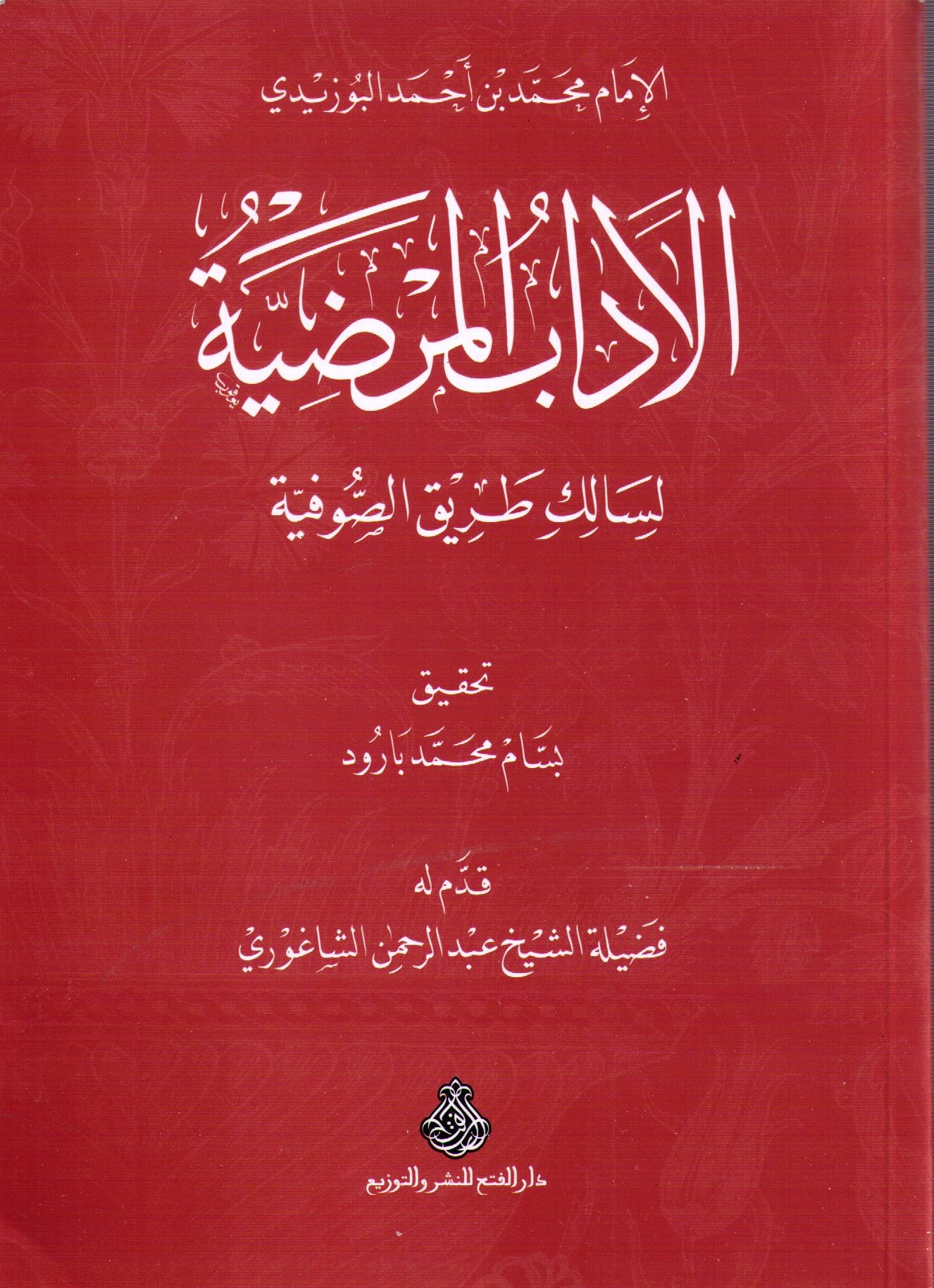
Al-Adab al-Mardiyya – الآداب المرضية للإمام البزيدي
By Imam Muhammad b. Ahmad al-Buyidi
See also Summary in English | Fihris | About the book → | The Author →
This course has helped me greatly in understanding the Path and what to focus on. It has not only taught me about adab with the shaykh, but how this adab is to be practiced in daily life. I wholeheartedly encourage more people to join and to reinvigorate themselves and their efforts in the Tariqa, especially if you feel you have become stagnant.
Anonymous
This course especially valuable for me as a new murid. It has brought clarity to the adab of the path and deepened my understanding of the relationship between the murid and the murshid. It has also helped me look at worldly matters through a different lens, one grounded in adab, accountability and the constant turning of the heart back to Allah (Subhanahu wa Ta‘ala). – The teaching is sincere and nurturing and conveys even subtle and complex concepts with clarity, using practical examples that bring the text to life.
A new murid in the UK
The course has been life changing.
Although the concept of adab was known to me in a generic sense, the actual depth of it eluded me. After studying this course, my view and understanding on this topic, interactions with my fellow murids and muqaddam, and of course my demeanour in front of our noble Shaykh has completely changed.
I now understand how deeply important it is to have adab and this has carried over with me into my day to day interactions also, with family members, colleagues and the wider community.
May Allah preserve Shaykha Umm Ayman and may we continue to benefit from her profound insight.
A brother in the UK
If you allow me, I would like to share with you what I experienced while studying Adab Mardiyya with our beloved Shaykha Umm Ayman.
In the beginning, when everything was new to me, I would come to class and sit however I could, without knowing the value of adab in relation to knowledge.
Over time, as I began to apply what we learned in each session and became more aware of the importance of adab, I started arriving a little bit earlier, sitting more attentively, wearing perfume, turning off my phone… And I discovered something beautiful — when you improve your adab, the message reaches you in a completely different, deeper way. The same text, when listened to with adab, reaches your soul and transforms you. That was the practical gift I received — it wasn’t theory; it was a transformation I was truly living.
Our dear Shaykha enriches everything with real stories, anecdotes she has lived and witnessed alongside Sayyiduna Shaykh. She speaks of difficulties with the tenderness of someone who has already gone through the path, and she describes the etiquettes of our tariqa with a beauty that touches the heart. She is not merely a teacher — she is a guide who has walked the path and extends her hand to you.
Therefore, if you are just beginning and feel that everything is confusing, or if you have been on the path for some time and long to deepen your understanding and reach excellence in the etiquettes of adab, I say to you from the bottom of my heart, this teaching can be a light on your path. It doesn’t just give you information; it gives you a light that guides you.
It is a blessing, and I feel great joy and gratitude to be able to share this with all of you.
A Brother in Madrid
Studying this precious book with Sayyidati Shaykha Umm Ayman has been one of the greatest blessings in my life – a turning point in my spiritual journey and a guiding light I can always return to.
It was the very first Sufi lesson I received when I was still new in the tariqa. It taught me how to uphold proper manners with my Shaykh and with other murids — beginning with outward actions and leading to the state of the heart. I realized that adab is not mere outer demeanor, but a training preparing the heart to stand in the Divine Presence.
Shaykha Umm Ayman showed me how to truly live this adab. Her guidance deepened my understanding of the path, strengthened my connection with my Shaykh — increasing his presence in my heart and my respect for him — and ultimately enhanced my reverence for Allah.
I am deeply grateful and very excited for this new opportunity to study this book again and learn more – and I truly hope that that our brothers and sisters will not miss the opportunity.
A sister in Türkiye
Studying Adab al-Mardiyya with Shaykha Umm Ayman has been a heart awakening experience! With each lesson, I feel like I’m embarking on a journey of introspection, gaining a deeper understanding of the tariqa and the special relationship between a murid and a murshid which brings us closer to Allah swt. — Shaykha Umm Ayman doesn’t just explain the text; she brings it to life which reflects her sincerity, wisdom, and tarbiyya under Sayyiduna Shaykh HafizhahumAllah. — I feel blessed to be in this course and highly recommend it to anyone seeking spiritual growth and transformation.